
Location: East-West Center, Honolulu, HI
Signed: February 24, 2026
Funded by: U.S. Trade and Development Agency
AHL has been awarded a USTDA-funded feasibility study for anew national hospital in the Republic of Palau. The agreement was formalized at a signing ceremony during The Pacific Agenda: Investment, Security, and Shared Prosperity Summit, with President Surangel Whipps Jr. of Palau, USTDA Deputy Director and Chief Operating Officer Thomas R. Hardy, and AHL President and CEO Bettina Mehnert executing the agreement.
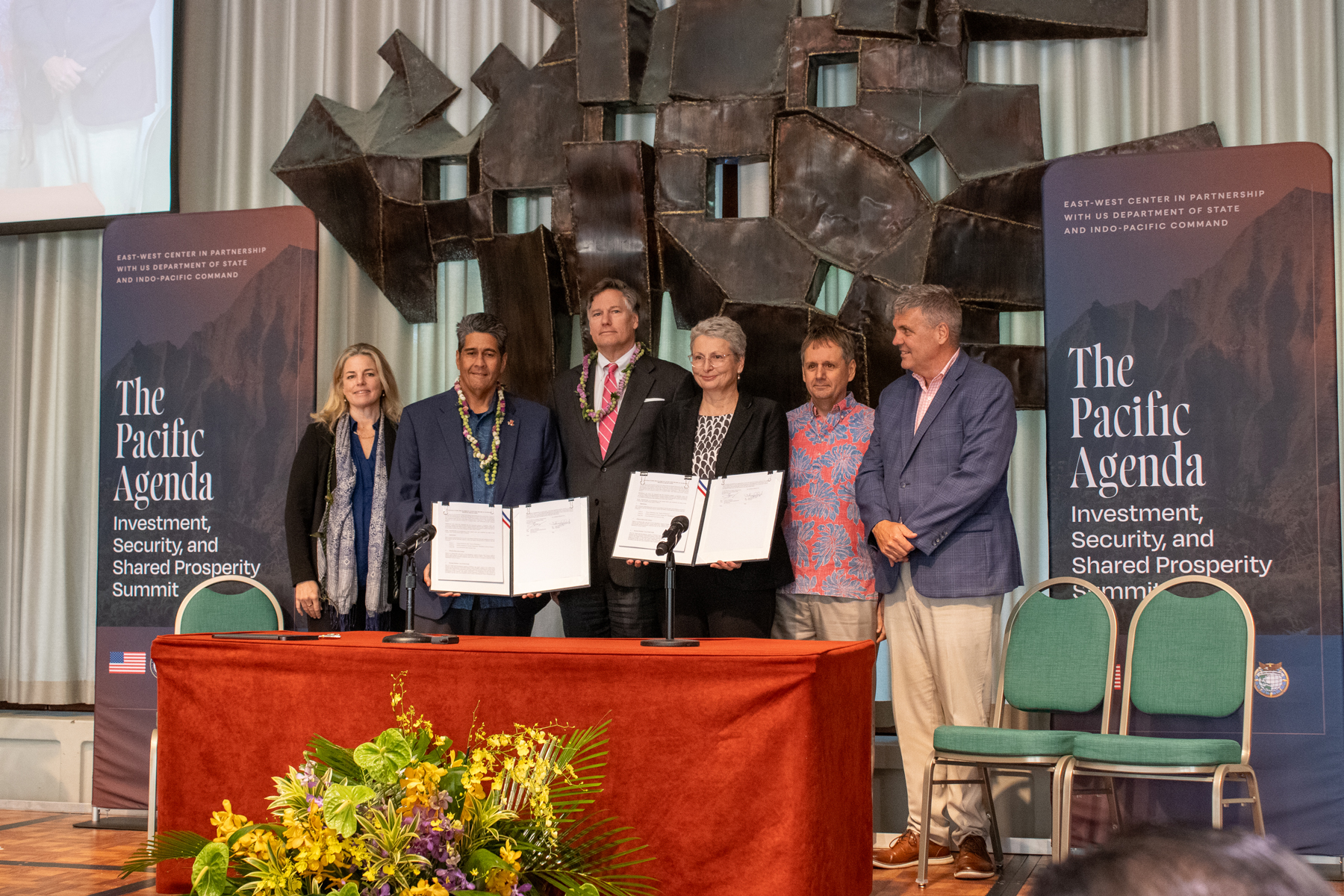
The selection follows months of collaboration between AHL, its consultants, and project team to develop a comprehensive approach to delivering the best possible healthcare experience for the people of Palau. The feasibility study will assess the viability of a new national hospital, addressing a critical need for improved healthcare infrastructure in the island nation.
For AHL, a firm approaching its 80th year, this project reflects a deep commitment to designing spaces that serve communities and strengthen the health and wellbeing of Pacific peoples.
Official USTDA Announcement
“USTDA-Backed Palau Hospital Relocation Contract Awarded to Hawaii-Based Firm | The U.S. Trade and Development Agency is strengthening the U.S.-Palau partnership by funding the development of a new modern hospital in Palau. Today, Palau’s Ministry of Public Infrastructure and Industries signed an agreement with Hawaii-based Architects Hawaii, Ltd. to carry out a USTDA-funded feasibility study…”
Read the full press release >
The signing took place during the Pacific Agenda Summit, a senior-level, invitation-only forum hosted by the East-West Center with support from the U.S. Department of State and U.S. Indo-Pacific Command. The summit brought together heads of government and senior officials from Pacific Island nations including, but not limited to Palau, Papua New Guinea, Fiji, Samoa, Tonga, the Cook Islands, and Guam, along with private investors, project developers, financial institutions, and philanthropic partners.
The forum explored investment opportunities in infrastructure, critical minerals, the digital economy, energy security, tourism, agriculture, health systems, and banking. Attendees worked alongside agencies including USTDA, the Millennium Challenge Corporation, and the Export-Import Bank to identify commercially viable projects aligned with U.S. and Pacific national priorities.
The summit operated on a core principle: that lasting economic development and regional security are best achieved through private sector-driven growth, with governments playing a focused and enabling role.
AHL President and CEO Bettina Mehnert joined a panel titled “From Strategy to Investment: US Government Levers and Private Capital,” moderated by Nicholas Snyder, Chief of Staff to the Deputy Secretary of State. Fellow panelists included:
The conversation focused on how U.S. government agencies facilitate funding for Pacific nations and how the private sector contributes to that ecosystem. Panelists discussed clearing pathways for island nation leaders to access development resources and shared examples of how private sector technology can help Pacific communities diversify their economies, build lasting infrastructure, and connect remote islands through centralized internet connectivity and expanded networks.
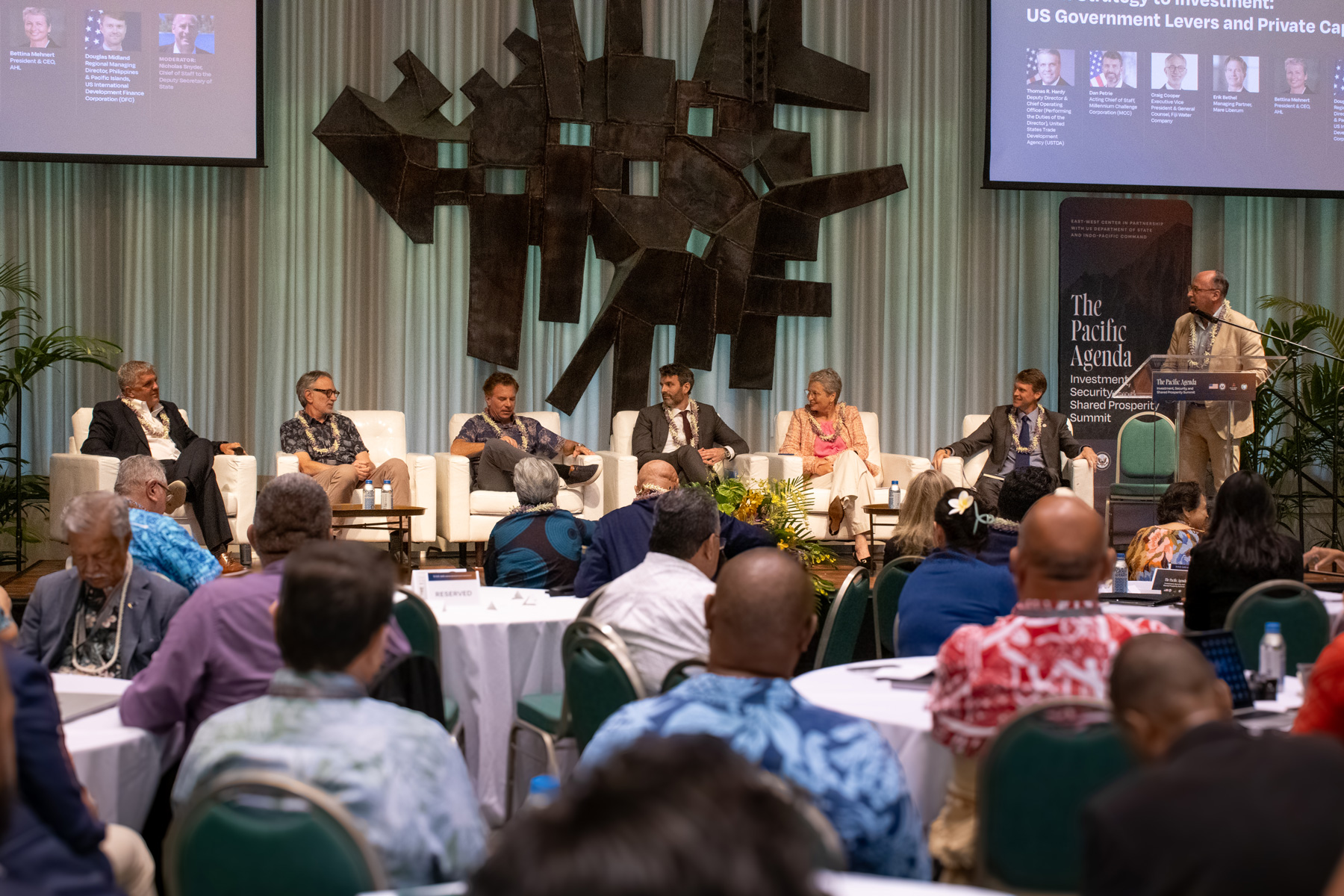
Mehnert spoke to the role that trust and long-term relationships play in making real progress across the Pacific. AHL's history in the region spans decades, from designing prototypical schools and dormitories in Koror, Palau in the late 1960s through the Trust Territory of the Pacific Islands, to completing the National Capitol of the Republic of Palau in Melekeok in 2006. That history includes work across American Samoa, the Federated States of Micronesia, Guam and the Commonwealth of the Northern Mariana Islands.
“We see our role as additive, not directive,” said Mehnert, “because it is our island partners who know their land, their people, and what the projects we design for them need to mean to the community they serve.”
AHL's approach is built on understanding what island conditions require: designing for salt air, hurricane and typhoon loads, humidity, and the realities of supply chain disruptions and limited labor resources. Hawaiʻi firms are uniquely positioned in this space, representing the United States and its resources while bringing the cultural understanding and relationships that come from being part of the Pacific.
Mehnert commented that one of the most consistent barriers to private investment in the region is the absence of reliable pre-development data. Feasibility studies like the Belau National Hospital project remove that barrier. When complete, the study will provide vetted site assessments, credible cost modeling, environmental clearance, and a realistic business case, shortening the distance from concept to construction and creating a genuine entry point for U.S. firms in construction, healthcare equipment, technology, and operations.
The Pacific is not a region where progress happens through transactions. It happens through relationships built over time, rooted in trust and a shared understanding of what island communities need. AHL has operated on that principle since its founders first committed to serving the Pacific nearly 80 years ago. That commitment remains unchanged.

This partnership with USTDA and the Republic of Palau is an example of building the conditions for investment that benefit island nations and United States alike. The nations of the Pacific share the commonality of the blue continent, cultures that run deep, and relationships that endure. AHL's ability to contribute meaningfully to this work comes from being part of that fabric, not outside of it.
As the feasibility study moves forward, AHL will bring the same values that have guided the firm since 1946: thoughtful design rooted in place, deep respect for the communities we serve, and the understanding that lasting impact is only possible when it is shaped by the people it is meant to serve.


